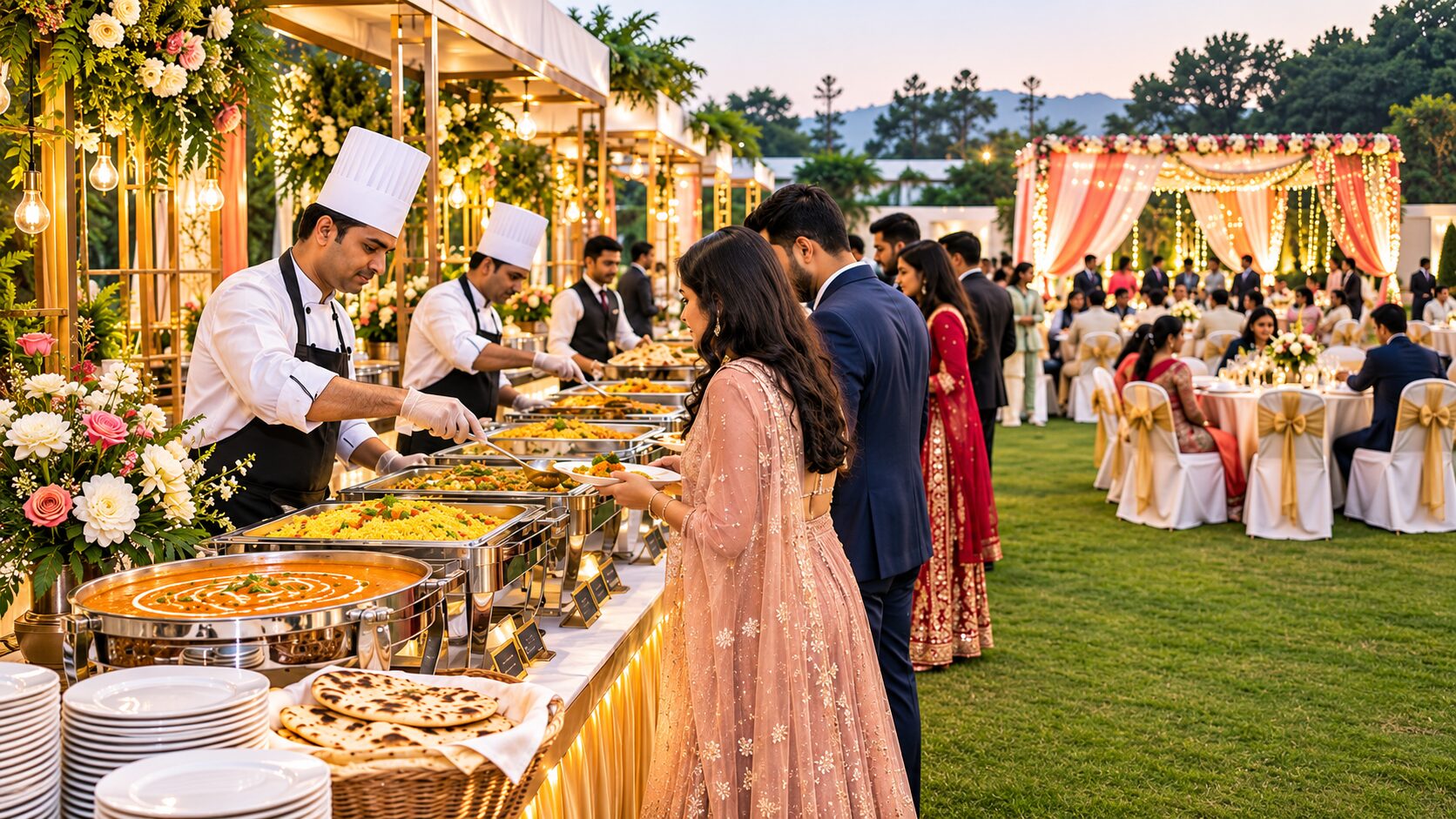
Guests may forget the centrepieces, but they always remember the food. A cold main course, a forty-minute buffet queue or a dessert that runs out before the last table gets up will colour how people talk about your wedding for years.
The caterer is also usually one of the biggest line items in the budget, often a third or more of the total spend. That makes it worth choosing slowly and carefully. This guide walks you through how to shortlist caterers, how to get real value out of a tasting session, how to work out menu quantities, and the red flags that should make you walk away.
Before you call anyone: get three things clear
Caterers quote very differently depending on what you tell them. Walk in with these three answers and every quote you get will be comparable.
- Your realistic food budget. Decide the per-plate figure you can live with, then add 10–15% for taxes, service charges and last-minute additions. Ask yourself whether you’d rather spend more per guest or invite more guests.
- A working guest count. You won’t have final RSVPs yet, but a range (say 250–300) is enough. Note how many guests are vegetarian, vegan, Jain, halal, or have allergies, and how many children are likely to attend.
- Your venue’s rules. Many venues have an empanelled list of caterers, charge a fee for outside vendors, or restrict live cooking stations, open flames or alcohol. Check kitchen space, water and power supply, and when the caterer can get access for setup. Ruling out caterers the venue won’t allow saves you weeks.
Building a shortlist of three to five caterers
Start with recommendations from friends who married recently, your venue’s preferred list, and your wedding planner if you have one. Online reviews help, but look for patterns rather than a single glowing or furious post.
On the first call, ask a few screening questions before booking a tasting:
- Are you available on our date, and how many events do you cater that same day?
- Have you worked at our venue before?
- What is your typical per-plate range for a menu like ours, and what does it include?
- What is the largest wedding you have catered, and how many service staff did you send?
- Can you share references from couples who married in the last six months?
A caterer who answers clearly and quickly at this stage usually communicates the same way on the wedding day. Drop anyone who is vague about pricing or capacity.
Tasting sessions: how to make them count
A tasting is your only chance to judge the food before you pay for it, so treat it as an inspection, not a free lunch.
Before The Tasting
- Ask whether the tasting is free, chargeable, or adjusted against the final bill once you book.
- Send your draft menu in advance so they cook the dishes you’ll actually serve, not their showpieces.
- Bring two or three people at most, ideally one person who knows the cuisine well. A larger group turns it into a party and blurs opinions.
- Eat lightly beforehand, and keep water nearby to reset your palate between dishes.
What To Judge At The Table
- Taste and seasoning. Is each dish balanced, or is everything leaning on salt, oil or ghee?
- Temperature. Hot food should arrive hot and cold food cold. If they can’t manage it for six people, they won’t for 300.
- Portion size. Ask whether the portions you’re seeing are what guests will get.
- Consistency. Ask who will cook on the day. If it’s a different team from the tasting chef, ask to meet them.
- Presentation. Ask to see the actual serveware, buffet counters and live-station setup, or photos from a recent event.
Questions to Ask During The Tasting
- How do you keep food at the right temperature across a long reception?
- What is your guest-to-server ratio for a buffet and for plated service?
- How do you label and separate vegetarian, vegan, Jain and allergen-free dishes?
- Can you adjust spice levels for older guests or children?
- What happens to leftover food? Can it be packed or donated?
Take notes and photos of every dish. After three tastings, the details blur.
Menu counts: how many dishes, and how many plates
More dishes don’t mean a better meal. A focused menu cooked well beats a long one where half the counters go cold. Use these rules of thumb as a starting point and adjust for your crowd.
How many dishes to serve
- Starters or passed snacks: 4–6. Plan 6–8 pieces per guest in the first hour, more if dinner starts late.
- Main course: 6–9. A mix of dry and gravy dishes, dal, rice, and 2–3 breads.
- Live counters: 1–3. Great for engagement, but each needs its own cook and space.
- Salads and accompaniments: 3–4. Raita, salad, pickle, papad.
- Desserts: 2–4. One hot, one cold, and one lighter option.
Keep vegetarian guests in mind: they should have as much choice as everyone else, not two token dishes.
Working out the headcount
Caterers charge on a guaranteed minimum, the number of plates you commit to and pay for even if fewer guests turn up. Getting this right protects both your budget and your guests.
- Expect fewer than you invite. Turnout is often 75–90% of the invited list, depending on how many guests travel from out of town. Track RSVPs closely in the final two weeks.
- Count children separately. Many caterers offer a reduced rate for children under a certain age. Confirm the age cut-off in writing.
- Add a buffer of 5–10%. Ask whether the caterer cooks extra over the guarantee by default, and whether you pay for it only if it’s served.
- Remember the people working. Photographers, drivers, the decor team and the band all need to eat. Ask about a cheaper vendor meal.
- Agree the final-count deadline. Most caterers want the final number 3–7 days before the event. Ask how they bill if more guests arrive than you confirmed.
When in doubt, guarantee slightly low and confirm that the caterer can scale up on the day. Running out of food is far more memorable than a little extra cost.
Red flags that should make you walk away
One of these on its own might have an innocent explanation. Two or more is a pattern.
- No written quote. If pricing only ever comes over the phone, it will change later.
- A price far below everyone else’s. Very low quotes are usually recovered through smaller portions, fewer staff, or a long list of extras added at the end.
- Vague answers on what’s included. Crockery, serving staff, counters, water, gas, transport and cleanup should all be spelled out, not “we’ll sort it out”.
- Reluctance to share references. A caterer with happy clients is proud to connect you.
- Pressure to book on the spot. “This discount ends today” is a sales tactic, not a reason.
- A tasting that doesn’t match your menu. If they only cook their best-sellers, you have no idea how your actual dishes will taste.
- No food safety licence or hygiene answers. In India, ask for an FSSAI registration or licence; elsewhere, ask for the local food-handling permit. Ask how food is transported and stored before service.
- Overbooking. Several weddings on the same evening means your event may get the B-team.
- Slow or patchy communication. If it takes four days to get a reply now, imagine the week before the wedding.
- No clear cancellation or refund policy. Anything left unwritten will be decided in their favour.
Your contract checklist
Once you’ve picked a caterer, make sure the contract covers every point below before you pay the advance.
- Event date, venue, start and end time of service
- Final menu, dish by dish, including live counters
- Per-plate price for adults, children and vendors, with taxes shown separately
- Guaranteed minimum headcount and the deadline for the final count
- How extra guests on the day will be billed
- Number of chefs, servers and supervisors on site
- Crockery, cutlery, linen, counters and decor that are included
- Setup, cleanup and waste-disposal responsibilities
- Payment schedule: advance, mid-payment and final balance dates
- Cancellation, postponement and refund terms
- Food safety licence number and liability if anything goes wrong
- Name and phone number of the on-site manager for the day
The bottom line
The right caterer isn’t the cheapest or the one with the longest menu. It’s the one whose food tastes as good for 300 guests as it did at the tasting, who answers your questions plainly, and who puts every promise in writing.
Shortlist carefully, taste with intent, do the headcount math honestly, and trust your instincts when something feels off. Get those right, and the food becomes one of the best memories of your day rather than a source of stress.